Godrej Kada Agrahara Price & Payment
Godrej Kada Agrahara is indicatively priced at approximately ₹12,000 per square foot — placing the 2 BHK from around ₹1.44 crore, the 3 BHK from roughly ₹1.80 to ₹2.16 crore, and the 4 BHK from about ₹2.4 crore. This page sets out the indicative pricing by configuration, how that rate compares to the Sarjapur Road corridor, the full all-in cost breakdown a buyer should budget, the payment-plan options, home-loan and EMI guidance, rental-yield scenarios, the capital-appreciation case, and the investor profiles the project suits. As a pre-launch project, the final cost sheet will be confirmed by Godrej Properties at the official launch; the figures below are carried as indicative and corridor-anchored. For cost discipline in the same Bengaluru market, Godrej MSR City — Phase 3 helps readers stay focused on total payable value rather than treating the quoted base number as the full answer.
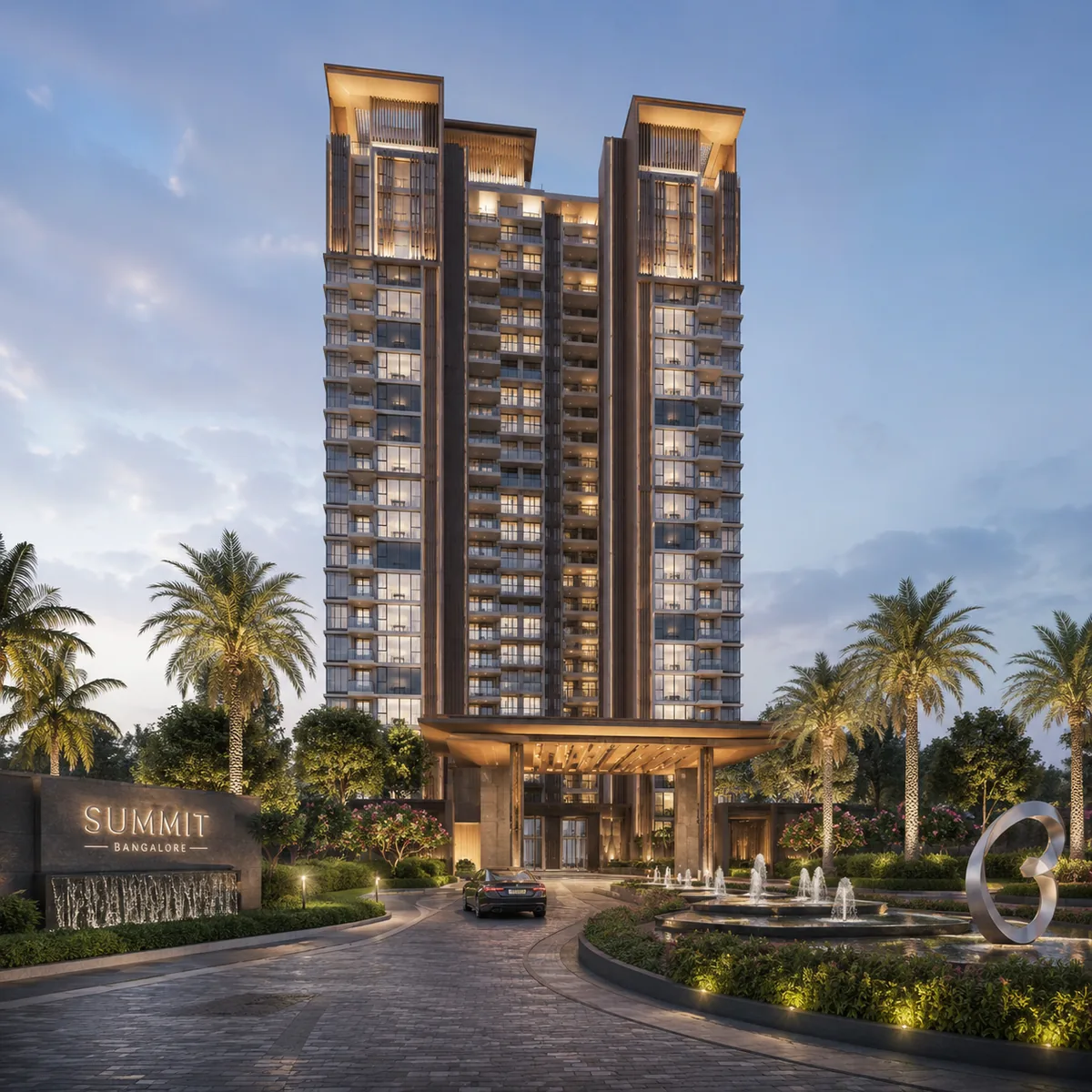
Indicative price by configuration
| Configuration | Size (sq.ft) | Indicative rate | Indicative price |
|---|---|---|---|
| 2 BHK | 1,100 – 1,300 | ~₹12,000/sq.ft | ~₹1.44 Cr onwards |
| 3 BHK | 1,400 – 1,800 | ~₹12,000/sq.ft | ~₹1.80 – 2.16 Cr onwards |
| 4 BHK | 2,000 – 2,500 | ~₹12,000/sq.ft | ~₹2.4 Cr onwards |
All three configurations are priced on a consistent indicative rate of approximately ₹12,000 per square foot. The internal consistency of that rate across formats is itself a credibility signal — the prices back-solve to one coherent per-square-foot figure rather than a patchwork of separately-quoted numbers.
How the price compares to the corridor
The Sarjapur Road corridor's Q1-2026 average sits at approximately ₹12,000 per square foot, with a range from around ₹8,900 in the outer pockets to roughly ₹13,200 in inner-zone premium projects. Godrej Kada Agrahara's indicative ~₹12,000 per square foot places it right at the corridor average — notably, not at a premium above it.
That positioning is significant. A national developer with Godrej's brand strength could plausibly command a premium over the corridor average; pricing at the line instead suggests a launch calibrated for volume absorption and resale headroom rather than maximal first-sale extraction. For a buyer, it means entering at the market rate with a recognised national brand — rather than paying a brand premium that compresses future appreciation.
| Benchmark | Approximate rate |
|---|---|
| Sarjapur Road corridor average (Q1 2026) | ~₹12,000/sq.ft |
| Corridor range (outer to inner-premium) | ₹8,900 – ₹13,200/sq.ft |
| Godrej Kada Agrahara (indicative) | ~₹12,000/sq.ft |
Full all-in cost breakdown
The headline price is the base apartment cost. The all-in outlay layers several components on top, and a buyer should budget for the complete stack rather than the base figure alone. The structure below is the standard Bengaluru high-rise cost build-up; exact figures will be on the official cost sheet.
| Component | Basis | Indicative weight |
|---|---|---|
| Base apartment price | Super built-up area × rate | The headline figure |
| Floor-rise charges | Premium per floor above a base level | Modest, scales with floor |
| Preferential location charges (PLC) | Corner / park-facing / better-oriented units | Modest, unit-specific |
| Covered car parking | Per slot | One-time |
| Clubhouse / amenity contribution | One-time facility contribution | One-time |
| Goods & Services Tax (GST) | On under-construction property | ~5% of agreement value |
| Maintenance deposit + corpus / sinking fund | Initial maintenance and reserve | One-time |
| Statutory deposits | BWSSB / BESCOM connection | One-time |
| Stamp duty | Karnataka stamp duty | ~5% of value |
| Registration | State registration | ~1% of value |
| Legal and documentation | Agreement and registration | One-time |
For a worked illustration on an indicative ₹1.44-crore 2 BHK base value: GST at ~5% adds roughly ₹7.2 lakh; stamp duty and registration at ~6% combined add roughly ₹8.6 lakh; covered parking, clubhouse contribution, maintenance corpus, statutory deposits, and legal typically add a further ₹6 to ₹9 lakh. The all-in figure therefore lands roughly 8 to 12 percent above the base-plus-charges price. A buyer planning the budget should reserve that margin so the registration-day outlay holds no surprises. Stamp duty, registration, and statutory deposits are payable to the relevant government authority and sit over and above the developer's cost sheet.
Payment-plan options
Pre-launch and under-construction Godrej projects typically offer a choice of payment structures. The three common formats:
1. Construction-Linked Plan (CLP). The buyer pays in stages tied to construction milestones — booking, agreement, then installments released against the basement, each slab band, brickwork, finishing, and finally registration or possession. The CLP aligns the buyer's outflow with the developer's progress, which both reduces the buyer's risk and spreads the cash requirement over the build period. This is the default and the most buyer-friendly structure for an under-construction high-rise.
2. Down-Payment Plan (DPP). The buyer pays a large share of the price up front — often 90 percent or more shortly after booking — in exchange for a discount on the base price. This suits cash-rich buyers comfortable carrying more risk for a lower headline rate, but it front-loads the outflow and exposure.
3. Flexi / Hybrid Plan. A middle path — a larger initial payment than a pure CLP (commonly 30 to 50 percent) for a partial discount, with the balance construction-linked. This suits buyers who want some price benefit without the full down-payment commitment.
The exact slab-by-slab CLP schedule, and which plans are offered, will be confirmed on the launch cost sheet. For most under-construction buyers, the CLP is the prudent default.
Home-loan and EMI guidance
Large national developers like Godrej typically secure pre-approval (APF — approved project financing) arrangements with the major banks and housing-finance companies, which speeds loan sanction and disbursement. Under a construction-linked plan, the lender disburses against the same milestones the buyer pays, and the buyer services interest (or pre-EMI) on the disbursed portion during construction, moving to full EMI after possession or full disbursement.
As an indicative EMI illustration on a ₹1.5-crore loan (after a typical 20 percent down payment on a ~₹1.9-crore all-in 2 BHK), at a representative 8.5 percent over 20 years, the full EMI works out to roughly ₹1.30 lakh per month; over 25 years, roughly ₹1.21 lakh. A 3 BHK at a higher loan quantum scales proportionally. Buyers should compare offered rates across at least two or three lenders, check the processing-fee and prepayment terms, and confirm the project's APF list at launch — an APF-approved project meaningfully shortens loan turnaround.
Rental-yield scenarios
The Sarjapur / Electronic City corridor supports healthy rental demand, with the 2 BHK in the deepest rental segment because the IT workforce drives consistent two-bedroom demand. The scenarios below are illustrative for a 2 BHK after possession, against an indicative all-in cost in the ₹1.8 to ₹1.9-crore range:
| Scenario | Monthly rent | Gross yield |
|---|---|---|
| Conservative | ₹42,000 – ₹46,000 | ~2.8 – 3.0% |
| Moderate | ₹48,000 – ₹54,000 | ~3.2 – 3.5% |
| Optimistic (post-metro) | ₹58,000 – ₹65,000 | ~3.8 – 4.2% |
The optimistic scenario assumes the Phase 3A metro to Sarjapur and the ring-road completions have landed by the rental horizon — both are documented re-rating catalysts that historically lift corridor rents and yields. The 3 and 4 BHK formats typically run slightly lower gross yields than the 2 BHK but command stronger absolute rents and a more stable, longer-tenure family tenant.
Yield versus alternatives
A residential investment should be weighed against the alternatives a buyer's capital could go into:
| Asset | Typical return profile | Notes |
|---|---|---|
| Godrej Kada Agrahara (rental) | ~3 – 3.5% gross yield + capital appreciation | Tangible asset, leverage via home loan, corridor appreciation |
| Bank fixed deposit | ~6.5 – 7.5% interest | Lower risk, no appreciation, fully taxable |
| Equity (broad index) | ~10 – 12% long-run, high volatility | Liquid, volatile, no leverage benefit |
| REITs | ~6 – 8% distribution + modest growth | Liquid real estate exposure, no end-use, no leverage |
The residential case is not the rental yield alone — it is the combination of rental income, capital appreciation, and the leverage a home loan provides. A buyer putting 20 percent down and financing the rest captures the appreciation on the full asset value while deploying a fraction of the capital — the structural advantage residential real estate holds over the unleveraged alternatives. On a corridor projected to appreciate 12 to 14 percent annually, that leveraged appreciation is the dominant component of the total return.
The capital-appreciation case
Three factors anchor the appreciation case at the indicative price:
1. Corridor trajectory. Sarjapur Road flat prices have risen approximately 15.7 percent in the trailing year and roughly 84 percent over three years, with analysts projecting 12 to 14 percent annual appreciation through 2030. Entering at the corridor average ahead of the metro and ring-road completions positions the buyer for that runway rather than chasing it.
2. Infrastructure re-rating. The Phase 3A metro terminating at Sarjapur, the Peripheral Ring Road, and the Satellite Town Ring Road are documented re-rating levers — metro arrival in particular has historically delivered step-changes in corridor residential values as it commissions.
3. Brand-floor resale strength. A Godrej-branded community holds resale value better than an unbranded project on the same corridor, because the resale buyer pool recognises and trusts the name. For the scarcity 3 and 4 BHK formats, this brand floor is especially valuable.
Investor profiles this project suits
| Profile | Fit | Rationale |
|---|---|---|
| Yield-and-growth investor (2 BHK) | Strong | Deepest rental segment, leveraged appreciation |
| Long-hold family end-user (3 BHK) | Strong | Liquid resale format, schools and amenities |
| Premium end-user (4 BHK) | Strong | Scarcity format, brand-floor resale |
| NRI investor | Strong | National brand, transparent listed developer, APF financing |
| Short-term flipper | Weaker | Under-construction horizon favours multi-year holds |
Pre-launch pricing advantage
The earliest buyers in a pre-launch typically secure the best entry pricing of the project's life cycle. Developers structure launch pricing to reward early commitment — pre-launch and launch-phase rates are usually the lowest, stepping up as construction progresses and inventory absorbs. Combined with first choice of unit, floor, and orientation, the pre-launch window is the optimal entry point for both the appreciation runway and unit selection. Registering interest now secures a priority position when the official launch pricing opens.
A note on indicative pricing
The pricing on this page is indicative, anchored to current corridor data and the project's stated configuration, and is carried ahead of the official Godrej Properties cost sheet. Final prices, all charges, the payment plan, and the GST treatment will be confirmed at the formal launch and on the RERA-registered cost sheet. To receive the official price sheet the moment it releases, register your interest via the contact page. A pricing page should make buyers slower and more exact, and Heart of Harmony supports that discipline around all-in value, payment slabs, add-ons, and contingency planning.
Want the unit-wise cost sheet and payment plan?
Register your pre-launch interest and our sales team will share the latest unit-wise cost sheet, the construction-linked payment schedule, and the RERA filing once issued. A sales associate will respond within one working day.
Talk to a Sales ConsultantFrequently Asked Questions
Godrej Kada Agrahara Price — Frequently Asked Questions
Godrej Kada Agrahara is indicatively priced at approximately Rs 12,000 per square foot - placing the 2 BHK from around Rs 1.44 crore, the 3 BHK from roughly Rs 1.80 to 2.16 crore, and the 4 BHK from about Rs 2.4 crore. All three configurations are priced on a consistent indicative rate. As a pre-launch project, the final cost sheet will be confirmed by Godrej Properties at the official launch.
The Sarjapur Road corridor's Q1-2026 average sits at approximately Rs 12,000 per square foot, with a range from around Rs 8,900 in outer pockets to roughly Rs 13,200 in inner-zone premium projects. Godrej Kada Agrahara's indicative Rs 12,000 per square foot places it right at the corridor average - notably, not at a premium above it, which leaves resale and appreciation headroom for the buyer.
The all-in outlay layers floor-rise charges, preferential location charges, covered car parking, a clubhouse contribution, GST at ~5% on under-construction property, a maintenance deposit and corpus, statutory deposits, stamp duty at ~5%, registration at ~1%, and legal costs on top of the base apartment price. The all-in figure typically lands roughly 8 to 12 percent above the base-plus-charges price; a buyer should reserve that margin.
Three formats are common: a Construction-Linked Plan (CLP) where the buyer pays in stages tied to construction milestones, a Down-Payment Plan (DPP) where the buyer pays a large share up front for a discount, and a Flexi or Hybrid Plan with a larger initial payment for a partial discount and the balance construction-linked. The CLP is the default and the most buyer-friendly structure for an under-construction high-rise.
Illustrative scenarios for a 2 BHK after possession run from a conservative Rs 42,000-46,000 per month (~2.8-3.0% gross yield), to a moderate Rs 48,000-54,000 (~3.2-3.5%), to an optimistic post-metro Rs 58,000-65,000 (~3.8-4.2%). The Sarjapur / Electronic City corridor supports healthy rental demand, with the 2 BHK in the deepest rental segment.
The earliest buyers in a pre-launch typically secure the best entry pricing of the project's life cycle. Pre-launch and launch-phase rates are usually the lowest, stepping up as construction progresses and inventory absorbs. Combined with first choice of unit, floor, and orientation, the pre-launch window is the optimal entry point for both the appreciation runway and unit selection.