Godrej Kada Agrahara Master Plan
The Godrej Kada Agrahara master plan organises approximately 21.6 acres at Kommasandra, Kada Agrahara, into a single high-rise community of 13 towers and around 1,600 apartments, structured around a central recreation and landscape core. This page explains how the site is laid out — the land-use allocation, the tower arrangement, the open-space strategy, circulation and parking, the below-ground infrastructure, and the sustainability backbone — and why that layout matters for daily living and long-term value. For another Bengaluru planning reference, Godrej MSR City — Phase 3 helps keep attention on density, circulation, landscape depth, and the way residents will move through the community.
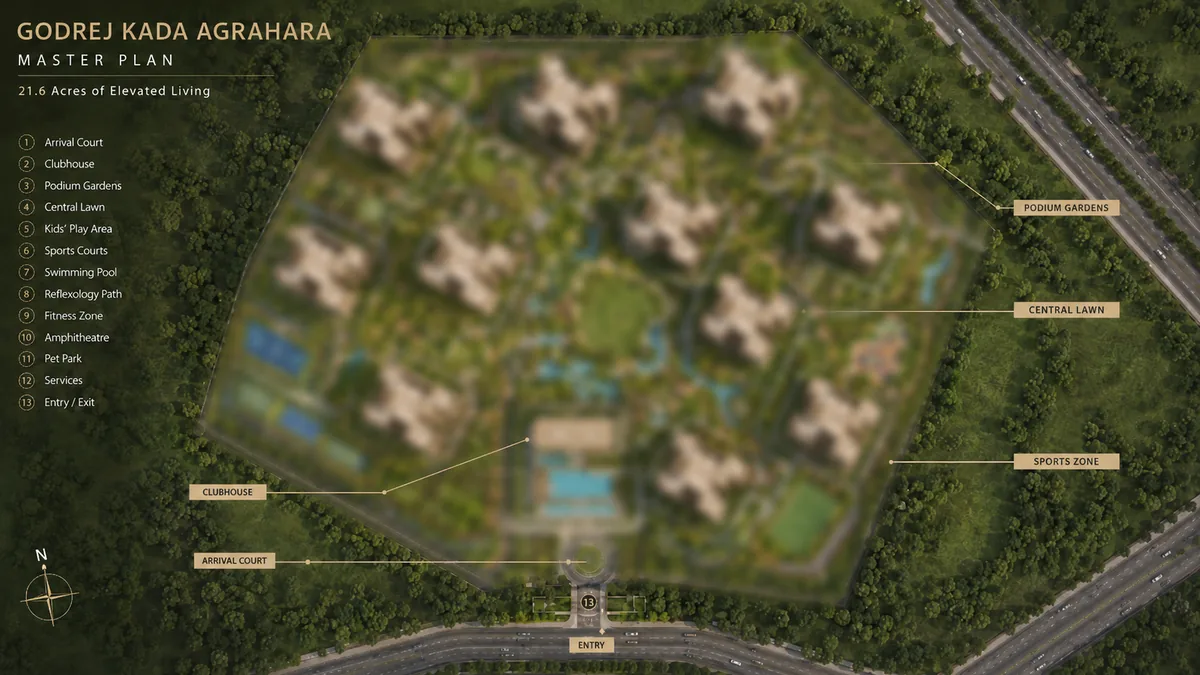
Master plan at a glance
Detailed master-plan drawings will publish with the official brochure; the structure below reflects the project's stated configuration and Godrej Properties' established master-planning approach for its larger Bengaluru communities.
| Parameter | Detail |
|---|---|
| Total land area | ~21.6 acres (87,646.9 sq.m) |
| Gross built-up area | ~2,95,363 sq.m |
| Number of towers | 13 |
| Floor configuration | 2B + G + 31 to 2B + G + 33 |
| Total units | ~1,600 |
| Basement levels | 2 per tower (parking + services) |
| Open / recreation strategy | Central landscaped core with green spine |
| Clubhouse | Grand community clubhouse precinct |
| Project cost (cited) | ~₹591 Crore |
Land-use allocation
The defining logic of the master plan is how the ~21.6 acres is divided between built footprint and open space. By concentrating the buildable area into 13 slim high-rise towers rather than spreading squatter blocks across the site, the plan keeps the ground-level built coverage low and releases the majority of the ground plane to landscape, recreation, and circulation. An indicative land-use split for a community of this configuration runs roughly as follows:
| Land use | Indicative share | Function |
|---|---|---|
| Tower footprints | ~25 – 30% | The 13 residential towers at ground level |
| Landscape and open space | ~40 – 45% | Central greens, courts, water features, play areas |
| Roads and circulation | ~10 – 15% | Internal driveways, entry plaza, pedestrian paths |
| Clubhouse and amenity precinct | ~5 – 8% | The central recreation core |
| Sports surfaces | ~5% | Tennis, basketball, futsal, courts |
The headline takeaway is that the built footprint is the minority of the site — the compact vertical massing is precisely what makes the generous open space possible, and the open-space share is the master plan's single strongest feature.
Tower layout and massing
The 13 towers step across a narrow height band that varies the skyline while standardising the construction system. This "build tall over a compact footprint" strategy is the foundation of the master plan's logic. By concentrating the buildable area into 13 relatively slim high-rises, the plan keeps ground-level built coverage low and releases the maximum possible area to landscape, water, sports, and amenity. The result is a community where the towers frame generous open courts rather than crowd them.
| Towers | Configuration | Upper floors |
|---|---|---|
| Towers 1, 3, 5, 7 | 2 Basements + Ground + 32 | 32 |
| Towers 2, 4, 6 | 2 Basements + Ground + 33 | 33 |
| Towers 8 to 13 | 2 Basements + Ground + 31 | 31 |
Building placement and orientation
The towers are arranged to optimise two things buyers consistently value: light and cross-ventilation. Slim tower plates with units oriented outward maximise the number of homes with good daylight and natural airflow — a meaningful comfort factor in Bengaluru's mild-but-humid climate, and one that reduces dependence on artificial cooling. Building placement also governs privacy and views: spacing the towers to avoid direct window-to-window overlooking, and positioning them so that a large share of units face the central green or the open perimeter rather than another tower.
In a stepped-height layout, the placement of the taller G+33 towers relative to the G+31 towers is designed so that height transitions read as a varied skyline rather than a wall, and so that lower towers retain light and outlook. When the master-plan drawing publishes, the relationship between a given tower's position, its orientation, and its outlook is among the most important things for a buyer to study.
Open space and green-belt design
The headline of any large master plan is how much of the site is not built on, and how that open area is programmed. With the built footprint concentrated into 13 vertical towers, Godrej Kada Agrahara's plan dedicates the bulk of its ground plane to a layered landscape: a central green spine threading between the tower clusters and connecting the entrance to the clubhouse and recreation core; landscaped courts and gardens at the base of the tower groups, giving each cluster its own pocket of green; water features integrated into the central landscape as both an amenity and a micro-climate moderator; and themed activity zones — children's play, senior citizens' plazas, fitness and yoga decks, and gathering courts — distributed so every tower has nearby access.
This programming approach, distributing recreation across the site rather than concentrating it in one corner, means amenity access is short from any tower, which matters in a 1,600-home community where concentration would otherwise create congestion at peak hours. The landscape is designed as a sequence of varied settings — shaded groves, open lawns, water, and activity courts — rather than a single undifferentiated lawn.
The clubhouse and recreation precinct
At the heart of the master plan sits the clubhouse and recreation precinct — the social anchor of the community. For a development of this scale, a substantial clubhouse is both expected and economically justified: 1,600 households support the kind of full-programme facility that smaller projects cannot. The precinct is planned to house the indoor amenities — gymnasium, multipurpose and banquet halls, indoor games, badminton and squash courts, a swimming pool, co-working lounge, and wellness facilities — while the surrounding landscape carries the outdoor sports courts, jogging and cycling tracks, and play areas. Positioning the clubhouse centrally keeps it within an easy walk of every tower and makes it the natural gravitational centre of community life. The full amenity programme is detailed on the amenities page.
Circulation and parking
The master plan separates vehicular and pedestrian movement — a hallmark of well-resolved large communities and a Godrej design priority. Vehicle entry is controlled at a secured gateway, with internal driveways routing traffic toward the basement parking ramps and keeping the central recreation zones vehicle-free. Pedestrian pathways connect the towers to the clubhouse, pool, and play areas without crossing the main driveways, so children and walkers move through the community on dedicated routes. This separation is not cosmetic — it is what makes a large community safe and pleasant to walk through, and it is one of the clearest markers of a thoughtfully-designed master plan.
Below-ground infrastructure
Two basement levels per tower carry covered parking, services, and utilities below grade. Locating parking below ground is central to the master plan's logic: it removes surface parking clutter, frees the ground plane for landscape and amenity, and gives residents secure, weather-protected parking. The basements also house the building services — electrical rooms, pump rooms, water tanks, and the like — keeping the surface clean and the towers' ground floors available for lobbies and entrances. EV-charging provision is planned across the parking levels, future-proofing the community for the electric-vehicle transition.
Sustainability and site infrastructure
Godrej Properties applies a consistent sustainability standard across its Bengaluru launches, typically targeting IGBC or green-building certification. The Kada Agrahara master plan is planned around a full set of environmental systems: a Sewage Treatment Plant with treated-water reuse for landscape irrigation and flushing; rainwater harvesting and recharge pits for storm-water management and groundwater recharge; solar-assisted common-area lighting to reduce the energy load and resident maintenance costs; on-site organic waste processing; and EV-charging provision in the parking levels.
These systems are not cosmetic. A working STP and rainwater harvesting materially reduce a large community's dependence on tanker water — a real operational advantage in a Bengaluru context where water security is a live concern. Solar-assisted lighting and organic waste processing lower the monthly maintenance burden that residents ultimately pay.
Safety and security
The master plan incorporates multi-tier security: a single controlled vehicular gateway, boom-barrier access, perimeter and common-area CCTV coverage, and visitor-management systems. Storm-water drainage and advanced fire-safety systems are designed into the site infrastructure, consistent with high-rise norms for towers of this height.
How to read the master plan as a buyer
When the official master-plan drawing publishes, three things are worth examining closely. First, tower position and orientation — which towers face the central green versus the perimeter, and how units are oriented for light and privacy; the slim-tower massing here is favourable for daylight across most units. Second, distance from your tower to the clubhouse and parking — the central clubhouse placement keeps this short, but specific tower assignments matter. Third, the open-space ratio and the landscape programme — the concentration of built area into 13 vertical towers is what makes the generous ground-level open space possible, and is the master plan's strongest feature.
The master plan is the document that determines daily livability more than any single apartment layout. Godrej Kada Agrahara's plan — compact vertical massing, a central recreation core, separated circulation, below-ground parking, and a full sustainability backbone — reflects a community designed for the long ownership horizon that a Godrej buyer expects. Pair this page with the floor plans and the gallery for the full picture.
Want the official master-plan drawing when it releases?
Register your pre-launch interest and our sales team will share the master plan, tower positioning, and amenity layout as soon as the official brochure publishes. A sales associate will respond within one working day.
Talk to a Sales ConsultantFrequently Asked Questions
Godrej Kada Agrahara Master Plan — Frequently Asked Questions
By concentrating the buildable area into 13 slim high-rise towers rather than spreading squatter blocks across the site, the plan keeps ground-level built coverage low — tower footprints around 25 to 30 percent — and releases roughly 40 to 45 percent to landscape and open space, with the balance to roads, the clubhouse precinct, and sports surfaces. The built footprint is the minority of the site, which is the master plan's single strongest feature.
The 13 towers step across a narrow height band — Towers 1, 3, 5 and 7 at G+32, Towers 2, 4 and 6 at G+33, and Towers 8 to 13 at G+31 — that varies the skyline while standardising the construction system. Slim tower plates are oriented to maximise daylight and cross-ventilation, with a large share of units facing the central green or open perimeter rather than another tower.
A central green spine threads between the tower clusters, linking the entrance to the clubhouse and recreation core, with landscaped courts at the base of each tower group, integrated water features, and themed activity zones distributed so every tower has nearby access. The landscape is programmed as a sequence of varied settings — shaded groves, open lawns, water, and activity courts — rather than a single undifferentiated lawn.
The master plan separates vehicular and pedestrian movement. Vehicle entry is controlled at a secured gateway, with internal driveways routing traffic toward the two-basement parking ramps and keeping the central recreation zones vehicle-free. Pedestrian pathways connect the towers to the clubhouse, pool, and play areas without crossing the main driveways.
The master plan is planned around a Sewage Treatment Plant with treated-water reuse, rainwater harvesting and recharge pits, solar-assisted common-area lighting, on-site organic waste processing, and EV-charging provision in the parking levels. A working STP and rainwater harvesting materially reduce a large community's dependence on tanker water, and solar-assisted lighting and waste processing lower the monthly maintenance burden.
Examine three things closely when the official drawing publishes: tower position and orientation — which towers face the central green versus the perimeter; distance from your tower to the clubhouse and parking; and the open-space ratio and landscape programme. The master plan determines daily livability more than any single apartment layout.